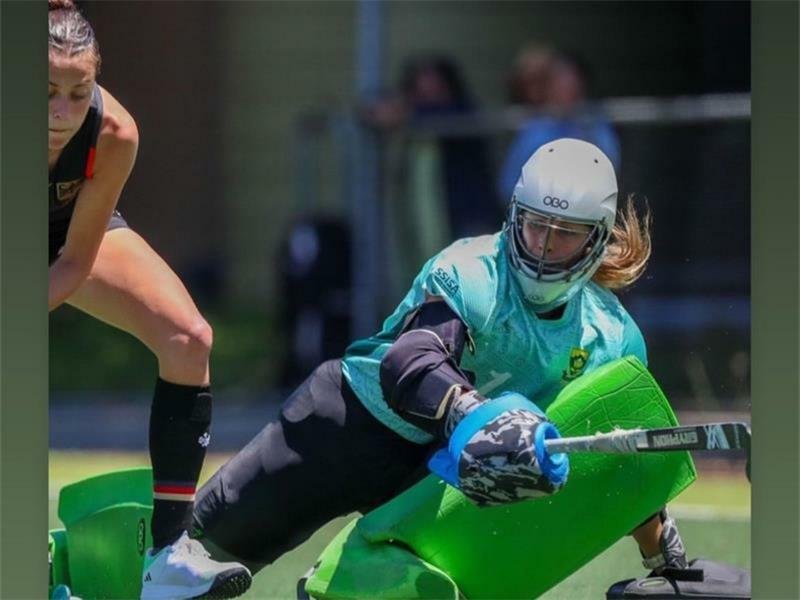
School hockey plays an important role in the development of players. This is according to Anelle Lloyd, who was South Africa’s goalkeeper at the 2024 Olympic Games in France.
This teacher and hockey coach at Hoërskool Hoogenhout in Bethal said her love for the sport began in primary school when she went to play hockey with a friend. Before that, she had mostly played netball.
Also read: Khosa Junior Hockey Club develops future players
“At the time, I was always in the third or fourth hockey team, but I enjoyed hockey and started practising a lot,” Lloyd said.
In 2011, while she was in Grade 11, she was selected for the Southern Gauteng team for the first time and thereafter represented the team every year.
She made her debut on the international hockey field in 2014 when she represented South Africa at the Commonwealth Games.
According to Lloyd, the foundation for a career in hockey is laid at school – not only technically and physically, but also in terms of discipline, teamwork and character. At school, young players get their first exposure to structured coaching, competition and the pride of playing for a team and their school.
Anelle Lloyd when she was honoured as goalie of the tournament at one of the international tournaments played in 2024.
“School hockey was the platform where I learned to play under pressure, read matches and constantly improve my skills. The competition between schools is often very strong and helps players develop their game quickly.
“Another important aspect is that school tournaments and interschool matches are often watched by provincial selectors,” Lloyd said. “This gives players the chance to be noticed and progress to provincial and national levels.
“Without strong school hockey structures, many players would not receive the exposure and opportunities needed to eventually compete at the highest level, such as the Olympic Games.”Lloyd believes a great deal of good work is being done by schools, clubs, coaches and volunteers to develop hockey.
Also read: St Dom’s ready for Knight of Champions
“Many people work with great passion to grow the sport and create opportunities for young players,” she said.
“However, there is always room for improvement. Hockey can still be developed further through greater access to facilities, better support for coaches, and increased exposure for the sport within communities and the media.
“When more schools and communities have access to quality coaching and facilities, it will help to expand the talent pool. South Africa has incredible talent and, with the right support, even more players could have the chance to excel at the international level.”
Her advice to players is to keep practising the basic skills consistently and never stop learning.
“The best players in the world still spend a lot of time on the simple things, such as first touch, passing and understanding the game. Hard work, discipline and a positive attitude make a big difference,” Lloyd said.
She added that it is important for players to take their fitness seriously, as modern hockey is fast and physically demanding.
Also read: Rugby rucks and hockey strikes fire up Jozi fests
“Players must be willing to put in extra work – not only during training sessions, but also individually.“For coaches, it is important to create an environment where players can grow, learn and develop confidence. A good coach does not only develop players’ skills, but also helps to build character, teamwork and a love for the game.
“When players and coaches work together with a shared vision and passion for the sport, it creates the best possible environment for success,” said Lloyd.
She said there are several routes players can follow after school to further develop their hockey. The most common path is to join a university or club where they can continue playing at a high level.
She said university hockey in South Africa is very strong and offers excellent coaching, facilities and competition.
“Many players continue to develop on this stage and are selected for provincial and national teams. I attended NWU Potchefstroom, which opened many doors for me nationally and internationally,” she said.
“There is also club hockey, which gives players the opportunity to compete against experienced and talented players. From these structures, players can be considered for provincial teams, national junior teams and eventually the senior national team.
“Internationally, there are also opportunities to play overseas or pursue studies with sports scholarships. This exposure helps players develop their game against different playing styles and at a high level.”
At Caxton, we employ humans to generate daily fresh news, not AI intervention. Happy reading!